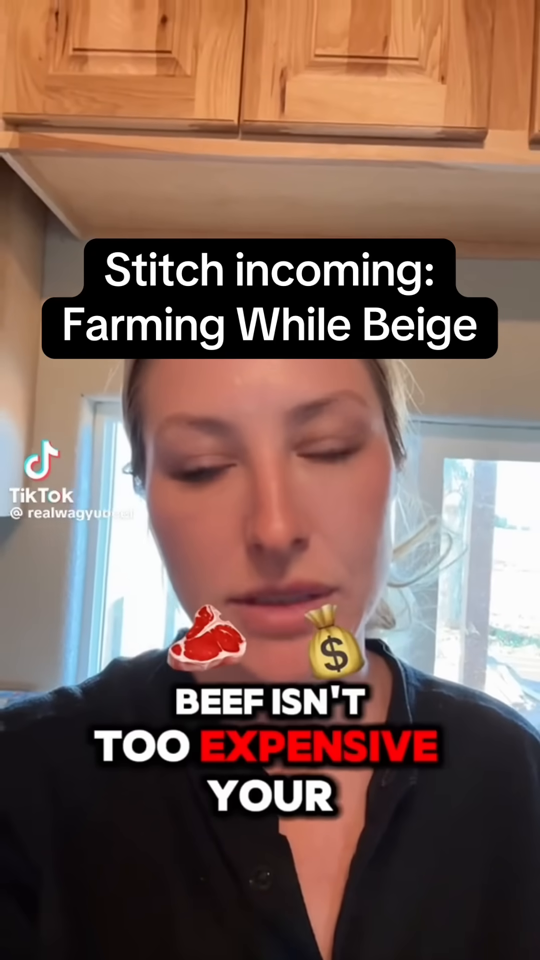
You're Not Buying Beef Because You're An Idiot
"Alternative agribusiness, as we stated earlier, was developed in the interest of the farmer rather than the public, so it makes sense that it wholeheartedly chose the Pull Strategy to put consumers at the service of the farmer. Instead of viewing every person as worthy of being fed a sustainable/healthy diet (and as a potential customer), alternative agribusiness simply divides the public into the virtuous people willing and able to pay high prices for food, and the non-virtuous people who aren't willing or, more often, simply aren't able, thereby showcasing its chronic lack of interest in or sympathy for the household economics of regular working families. As is discussed in Appendix B, alternative agribusiness was able to make some headway with consumers anyway owing to artificially-elevated spending power that is rapidly vanishing.
You may recognize this for what it is: plain old luxury marketing appealing to
peoples' desire to be elite. The difference between farm-to-table and, say, Rolls Royce, is a simple matter of honesty: the latter doesn't pretend that an ideal world consisting of a Rolls in every garage is possible or even desirable. Farm-to-table, on the other hand, has the mind-bending task of convincing people that the commodities it produces are, in fact, luxury items. It accomplishes this by a.) proclaiming its vision of an ideal world where everyone's eating hugel-grown carrots and pasture-raised chicken at a 3X price premium, and b.) suggesting this ideal world doesn't exist because most people - but not you - are too stingy to pay the real price of food. Farm-to-table threads a tiny needle of buyer psychology: you're not paying 3X the price of food because the product is 3X better (as is the case with e.g. luxury cars); you're paying it because it costs 3X more to be a part of “the solution;” a better, selfless, and more conscientious person."
...read more
"Alternative agribusiness, as we stated earlier, was developed in the interest of the farmer rather than the public, so it makes sense that it wholeheartedly chose the Pull Strategy to put consumers at the service of the farmer. Instead of viewing every person as worthy of being fed a sustainable/healthy diet (and as a potential customer), alternative agribusiness simply divides the public into the virtuous people willing and able to pay high prices for food, and the non-virtuous people who aren't willing or, more often, simply aren't able, thereby showcasing its chronic lack of interest in or sympathy for the household economics of regular working families. As is discussed in Appendix B, alternative agribusiness was able to make some headway with consumers anyway owing to artificially-elevated spending power that is rapidly vanishing.
You may recognize this for what it is: plain old luxury marketing appealing to
peoples' desire to be elite. The difference between farm-to-table and, say, Rolls Royce, is a simple matter of honesty: the latter doesn't pretend that an ideal world consisting of a Rolls in every garage is possible or even desirable. Farm-to-table, on the other hand, has the mind-bending task of convincing people that the commodities it produces are, in fact, luxury items. It accomplishes this by a.) proclaiming its vision of an ideal world where everyone's eating hugel-grown carrots and pasture-raised chicken at a 3X price premium, and b.) suggesting this ideal world doesn't exist because most people - but not you - are too stingy to pay the real price of food. Farm-to-table threads a tiny needle of buyer psychology: you're not paying 3X the price of food because the product is 3X better (as is the case with e.g. luxury cars); you're paying it because it costs 3X more to be a part of “the solution;” a better, selfless, and more conscientious person."
...read more